The IPM PrototypeFinal version PrototypeFinal version Online software Online softwareThe ChriLCU PrototypeFinal version |

Final version
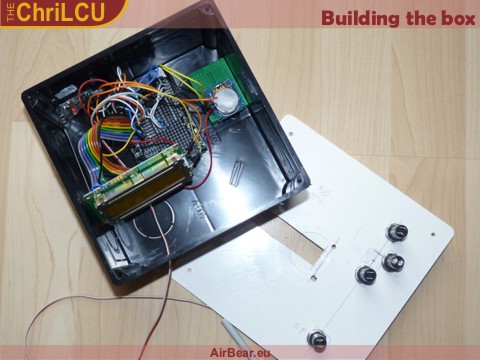
After building the prototype and testing the basic firmware functions like switching an RCO, a final version was built. It consisted mainly of the same components as the prototype, but now all the components were given a nice "home":
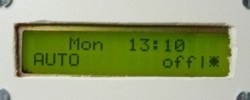
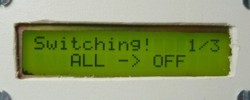
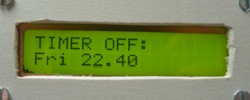
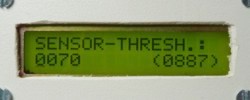
 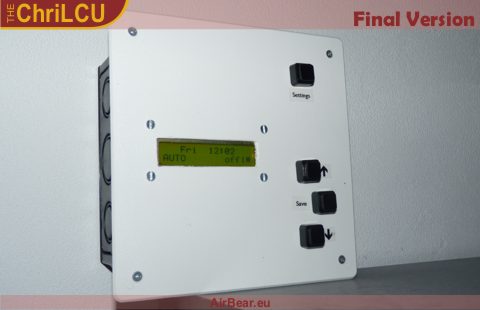 Here are some display samples:
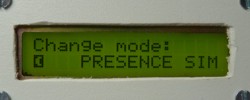
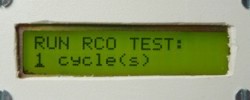
Here are some details about the modes of operation: Besides the two obvious functions ON and OFF, the first firmware had two additional modes: TIMER: The timer mode works like a regular timer: It switches all RCOs on at the specified "on-time" and off at the respective "off-time" (which can be set for each weekday). AUTO: This is an enhanced timer mode that uses the light-sensor to determine when to switch the RCOs on within the normal timer-timeframe. In case the sensor is not connected, it is assumed, that it's always dark - thus this mode works like the regular TIMER-mode In addition, this mode has a "Stay on"-option which can be activated as long as the switch is still off (light sensed or out of timeframe). In this case the controller switches to the ON-mode and stays in this mode until you manually select a different mode. Later on, another mode extended the ChriLCU's operation: PRESENCE: This is a presence simulation that starts at dusk (like the AUTO-mode described above), but only swicthes on a single RCO when the mode is activated. After a random time period, the RCO is switched off. The CriLCU then waits a few minutes to switch on a different RCO. This process is repeated until the set "off-time". The settings-menu allows the user to set certain parameters: Apart from setting current time and date, you can set the average "light-on"-time for the presence mode (this value is then randomly shortened or prolonged) as well as the number of RCOs to be used for it. Set the threshold for the light sensor (so the lights only go on when it's dark), all on- (one time) and off-times (one time for each weekday) or run a special RCO-test-cycle. There is - of cousre - also a setting for the RCO-system code and the units to be used for switching as well as an automatic resyncing option. |
 MyPlan